
AlmaLinux: The Community-Driven Enterprise Linux Distribution
Introduction
AlmaLinux OS is a free, open-source, enterprise-grade Linux distribution designed as a drop-in replacement for Red Hat Enterprise Linux (RHEL). It was created in response to the shift in CentOS Linux policy, which moved from a stable downstream distribution to the rolling-release CentOS Stream model.
Built for stability, long-term support, and production environments, AlmaLinux has quickly become one of the most trusted operating systems for servers, cloud infrastructure, and enterprise workloads.
This article provides a comprehensive, Ghost-optimized overview of AlmaLinux: its history, philosophy, features, use cases, and why it has become a top choice for system administrators and businesses worldwide.
What Is AlmaLinux?
AlmaLinux OS is a binary-compatible RHEL clone, meaning applications and workloads certified for RHEL run on AlmaLinux without modification. It follows the same release cadence and security updates as RHEL, ensuring long-term consistency and reliability.
AlmaLinux is maintained by the AlmaLinux OS Foundation, a nonprofit organization that guarantees the project remains community-owned and vendor-neutral.
Key Characteristics
- 1:1 binary compatibility with RHEL
- Free to use, forever
- Enterprise-grade stability
- Long-term support (10 years per major release)
- Backed by a transparent governance model
Why AlmaLinux Was Created
When CentOS Linux was discontinued as a stable downstream rebuild of RHEL, organizations faced a difficult choice:
- Migrate to a paid RHEL subscription
- Accept the instability of a rolling-release distribution
- Rebuild infrastructure on a new platform
AlmaLinux was created to solve this exact problem:
a stable, predictable, and free enterprise Linux OS, without vendor lock-in.
AlmaLinux vs CentOS Stream vs Rocky Linux
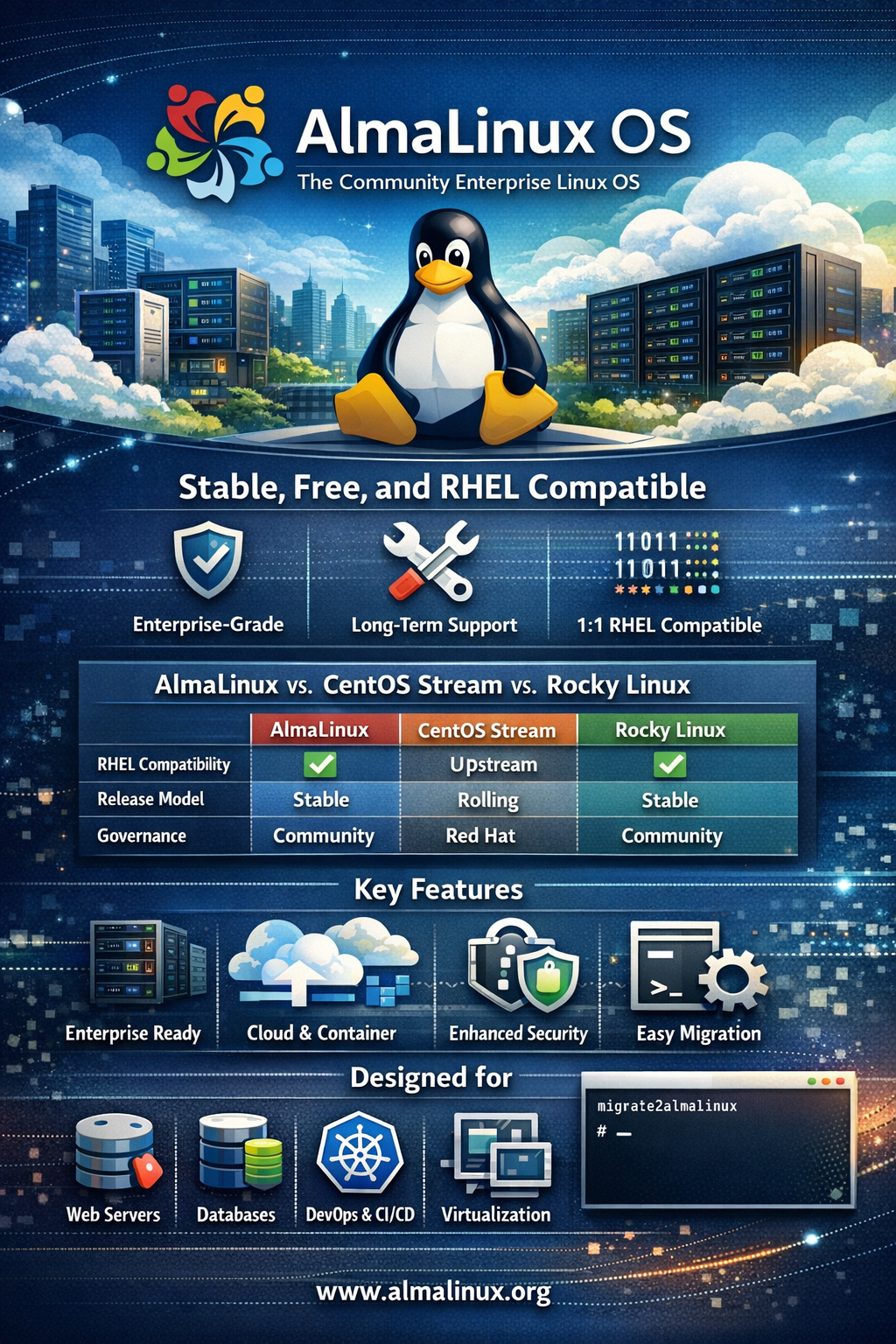
| Feature | AlmaLinux | CentOS Stream | Rocky Linux |
|---|---|---|---|
| RHEL Compatibility | ✅ Full | ❌ Upstream | ✅ Full |
| Release Model | Stable | Rolling | Stable |
| Governance | Non-profit foundation | Red Hat | Community |
| Target Audience | Production servers | Developers | Production servers |
AlmaLinux and Rocky Linux share a similar mission, but AlmaLinux differentiates itself through strong foundation governance, early enterprise backing, and fast security response times.
Core Features of AlmaLinux
1. Enterprise-Grade Stability
AlmaLinux is built for mission-critical workloads:
- Web servers
- Databases
- ERP systems
- Virtualization hosts
- Kubernetes nodes
Updates prioritize security and reliability, not experimental features.
2. Long-Term Support (LTS)
Each AlmaLinux major version is supported for up to 10 years, including:
- Security patches
- Bug fixes
- Kernel updates
- Hardware enablement
This makes AlmaLinux ideal for environments where frequent OS upgrades are not acceptable.
3. RHEL Binary Compatibility
AlmaLinux maintains strict binary compatibility with RHEL:
- Same ABI
- Same RPM packages
- Same kernel behavior
This ensures:
- Seamless migration from CentOS or RHEL
- Compatibility with enterprise software
- Vendor certifications remain valid
4. Cloud and Container Ready
AlmaLinux runs seamlessly on:
- AWS
- Azure
- Google Cloud
- OpenStack
- VMware
- Proxmox
Official images are available for cloud providers, containers, and virtualization platforms.
5. Security and Compliance
AlmaLinux includes:
- SELinux (enabled by default)
- OpenSCAP
- FIPS-ready cryptographic modules
- Secure Boot support
It is suitable for regulated industries such as finance, healthcare, and government.
Typical Use Cases
Web and Application Servers
- Apache / Nginx
- PHP, Python, Node.js
- REST APIs and microservices
Database Servers
- MySQL / MariaDB
- PostgreSQL
- MongoDB
DevOps and CI/CD
- Docker
- Kubernetes
- Ansible
- Terraform
Virtualization and Hosting
- KVM
- VMware
- Cloud hosting providers
- VPS environments
Migration to AlmaLinux
AlmaLinux provides an official migration script that allows:
- CentOS 8 → AlmaLinux
- RHEL → AlmaLinux (where licensing permits)
The migration is:
- Fast
- Non-destructive
- Proven in production environments
This makes AlmaLinux especially attractive for organizations with large legacy infrastructures.
Package Management and Software Availability
AlmaLinux uses:
dnfpackage manager- RPM packages
- EPEL repository
- Third-party enterprise repositories
This ensures access to:
- Modern developer tools
- Server software
- Monitoring and automation tools
Community and Ecosystem
The AlmaLinux community is:
- Active and growing
- Transparent in decision-making
- Welcoming to contributors
Major hosting providers, cloud vendors, and enterprises actively support the ecosystem.
Why Choose AlmaLinux?
Choose AlmaLinux if you need:
- A free enterprise Linux OS
- Long-term stability
- RHEL compatibility without cost
- Vendor-neutral governance
- A future-proof server platform
For many organizations, AlmaLinux has become the default successor to CentOS Linux.
Final Thoughts
AlmaLinux represents the next generation of community-driven enterprise Linux. It combines the stability of traditional enterprise distributions with the openness and flexibility modern infrastructure demands.
Whether you are running a single server or managing thousands of nodes, AlmaLinux offers a robust, predictable, and professional Linux foundation.