
Claude Opus 4.6 Released Today: Adaptive Thinking Explained + How It Supercharges DevOps & Coding in 2026
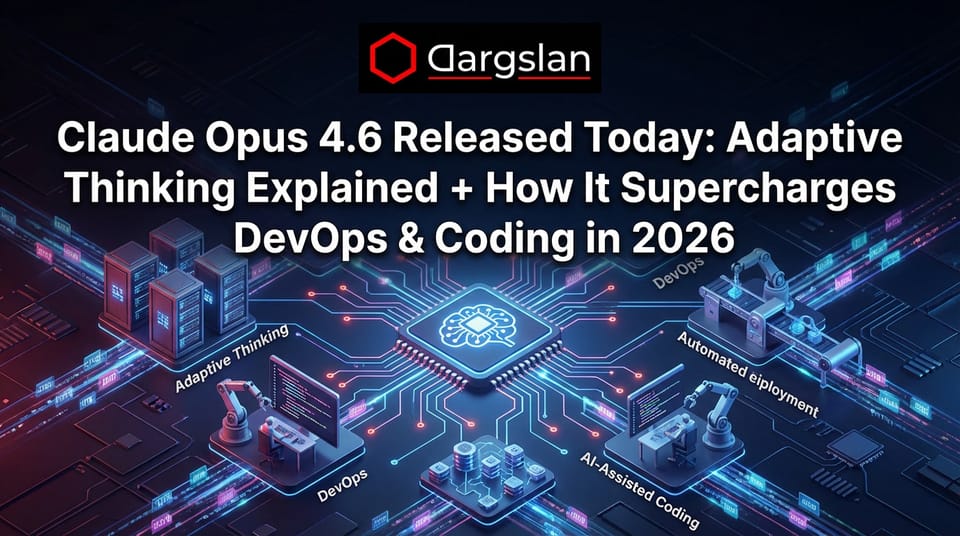
Anthropic just dropped Claude Opus 4.6 on February 5, 2026 — upgrading their flagship model with sharper coding, longer agentic runs, better self-correction, a 1 million token context window (beta), and the headline new feature: adaptive thinking.
For DevOps engineers, platform teams, sysadmins, and full-stack devs, this isn’t hype — it’s a direct boost to daily chaos: migrations, debugging massive repos, security audits, GitOps planning, and turning vague “fix this outage” prompts into reliable multi-step plans.
Here’s the breakdown: what adaptive thinking really means, why Opus 4.6 stands out today, and how to apply it right now in your 2026 stack.
What Is Adaptive Thinking? (Human + AI Perspective)
In humans, adaptive thinking is the ability to flexibly shift strategies, mental models, or depth of analysis when the problem changes, new data arrives, or the initial path fails. It’s not rigid step-by-step logic — it’s knowing when to zoom in deeply (e.g., root-causing a kernel panic) versus when to move fast (e.g., quick kubectl scale during traffic spike). Top performers in IT ops, SRE, or engineering excel here: they balance speed, depth, and context-switching without getting stuck.
In AI (Claude Opus 4.6 specifically), adaptive thinking replaces the old binary “extended thinking on/off” toggle. Now the model reads your prompt/task context and automatically decides how much deeper reasoning to apply:
- Simple/reflexive tasks? → Fast response, minimal internal deliberation.
- Ambiguous, multi-step, high-stakes, or novel problems? → Ramps up chain-of-thought, self-review, alternative exploration, error-checking — without you explicitly saying “think step by step” every time.
- Default (high effort): Almost always thinks deeply when it helps.
- Adjustable via new effort controls: low / medium / high (default) / max → trade speed, cost, and quality.
This is paired with interleaved thinking (shows reasoning live) and makes Opus 4.6 feel more like a thoughtful teammate than a quick-answer bot. Anthropic says it sustains longer autonomous sessions, catches its own mistakes better, and handles larger codebases more reliably.
Key Upgrades in Claude Opus 4.6 (Feb 2026 Release Highlights)
- 1M token context window (beta) → Process entire monorepos, full Helm charts + logs + alerts, or multi-service YAML dumps in one go.
- Top benchmarks: Leads on Terminal-Bench 2.0 (agentic CLI coding), Humanity’s Last Exam (multidisciplinary reasoning), GDPval-AA (economic-value tasks, beating GPT-5.2 by ~144 Elo), BrowseComp (hard web research).
- Agent teams (preview in Claude Code) → Split tasks across sub-agents (e.g., one plans migration, one writes quadlets, one scans security).
- Context compaction (beta) → Auto-summarizes old context for ultra-long runs without token blowup.
- Pricing unchanged: $5/$25 per million input/output tokens (higher for 1M context beyond 200k).
- Available now: claude.ai, API (model: claude-opus-4-6), Azure Foundry, Google Vertex AI, AWS Bedrock, GitHub Copilot, Cursor, etc.
Practical Wins for DevOps & SysAdmins in 2026
Adaptive thinking shines on volatile, real-world tasks where rigid prompting fails.
| Task | Without Adaptive Thinking (Older Models) | With Opus 4.6 Adaptive Thinking | Relevant Dargslan Free Book Tie-in |
|---|---|---|---|
| Docker Compose → Podman quadlet migration | Often shallow, misses systemd/firewalld edges | Dynamically deep-dives compose + units → suggests secure quadlets | Docker & Podman in 2026 |
| Hardening production Bash scripts | Quick rewrite, subtle bugs slip through | Self-reviews for strict mode, logging, xargs/parallel safety | Bash Mastery 2026 |
| GitOps repo review (ArgoCD health) | Surface suggestions | Explores App of Apps, Kustomize overlays, probe gaps adaptively | Git from Beginner to GitOps Hero |
| Novel vuln pattern hunting in deps | Scanner-like only | Hunts subtle patterns scanners miss (like its 500+ zero-day finds) | Upcoming DevSecOps free series |
| Observability stack from scratch | Generic Prometheus/Grafana copy-paste | Balances Loki/Tempo setup for your microservices context dynamically | Observability for Full-Stack 2026 (premium) |
Pro tip: Upload code/logs/YAML directly to claude.ai or API → prompt with “Use adaptive thinking to plan this migration securely” — watch it self-adjust depth.
Bottom Line for 2026 IT Pros
Opus 4.6 + adaptive thinking moves AI closer to a reliable “junior SRE / pair-programmer” that owns hours-long tasks with less hand-holding. It won’t replace you, but it multiplies your output on the boring/repetitive/hard parts — especially when paired with battle-tested knowledge from real guides.
Get Started Today (Feb 5, 2026):
- Jump in at https://claude.ai — select Opus 4.6 (live now; Pro unlocks higher limits + 1M beta).
- API devs: Use claude-opus-4-6 + effort headers (docs: https://platform.claude.com/docs/en/build-with-claude/adaptive-thinking).
We’ll post follow-ups soon: hands-on tests like “Opus 4.6 adaptive migration of a real 20-service Compose stack to Podman quadlets.”
Stay adaptive — the frontier just got smarter.
—The Dargslan Publishing Team
February 5, 2026