
Cloudflare Dashboard & API Service Issues: What’s Happening Right Now (Live Analysis)
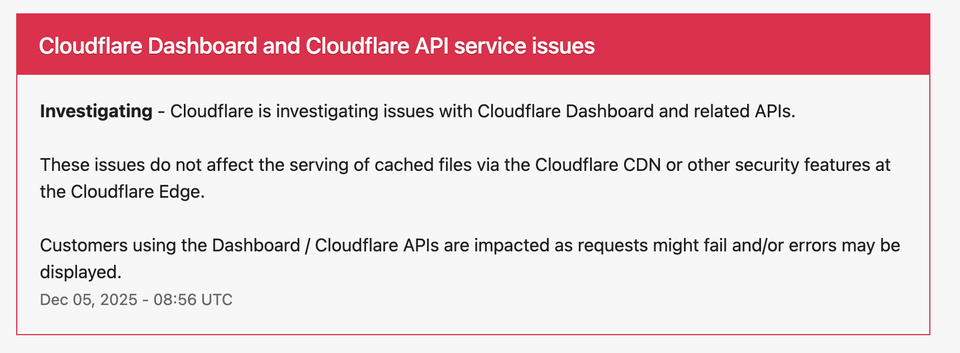
On December 5, 2025, Cloudflare announced that it is currently investigating service disruptions affecting both the Cloudflare Dashboard and related Cloudflare APIs. Although the issue does not impact the serving of cached content through Cloudflare’s CDN, it is significantly affecting platform management functionality for developers, website owners, and enterprises relying on API-driven workflows.
According to Cloudflare’s official status update:
“Cloudflare is investigating issues with Cloudflare Dashboard and related APIs. These issues do not affect the serving of cached files via the Cloudflare CDN or other security features at the Cloudflare Edge. Customers using the Dashboard / Cloudflare APIs are impacted as requests might fail and/or errors may be displayed.”
This incident means that while public-facing websites and applications remain online, backend operations, automations, and administrative tasks may fail or return errors such as 500 Internal Server Error. For businesses that depend heavily on Cloudflare’s API for deployment, DNS management, firewall configuration, or analytics retrieval, this outage can cause temporary workflow disruptions.
What’s Impacted
🔧 Cloudflare Dashboard
Users may experience:
- Inability to log in
- Slow loading times
- Dashboard panels failing to display data
- Error messages during configuration changes
🔌 Cloudflare API
Several tools and integrations that rely on the API may fail, including:
- Automated DNS management
- Deployment systems
- Firewall rule updates
- SSL certificate checks
- API-based reporting and analytics
These failures may result in:
- Timeouts
- Failed requests
- HTTP 500 errors
- Incomplete data responses
What’s NOT Impacted
Cloudflare confirmed that CDN and edge security functions are operating normally, meaning:
- Cached content continues to be delivered globally
- DDoS protection is active
- WAF (Web Application Firewall) rules at the edge continue working
- Bot mitigation systems remain functional
End users visiting websites protected by Cloudflare should not notice any disruption in content delivery.
Why This Matters
Cloudflare plays a central role in the infrastructure of millions of websites, APIs, and SaaS platforms. Even if visitor-facing services remain stable, administrative outages can have major downstream effects, especially for:
- DevOps teams
- SaaS platform engineers
- Security administrators
- Companies relying on CI/CD with Cloudflare integration
- DNS automation systems
- API-dependent update pipelines
Such outages highlight how deeply Cloudflare is embedded in the daily operations of the modern internet.
What Users Should Do Right Now
✔️ 1. Avoid making major configuration changes
DNS edits, firewall rule updates, and SSL adjustments may fail or produce unexpected results.
✔️ 2. Pause automated scripts that rely on the Cloudflare API
This prevents:
- Repeated failures
- Unexpected configuration rollbacks
- Deployment errors
✔️ 3. Monitor Cloudflare’s official status page
The incident is logged here and updated in real time.
✔️ 4. Prepare fallbacks if your system requires API calls
For example, if your deployment pipeline can skip non-critical Cloudflare steps, activate that fallback mode.
Potential Causes (Speculative Based on Past Outages)
While Cloudflare has not yet released the technical details, previous dashboard/API outages have been caused by:
- Database cluster issues in core regions
- Global configuration rollout failures
- Internal load balancer faults
- Unresponsive services inside Cloudflare’s control plane
- Rate limiting misconfigurations
- Bugs introduced in software updates
This seems consistent with a control-plane outage only, not an edge-network failure.
Conclusion
This Cloudflare incident underscores the difference between edge availability (public traffic) and control-plane stability (management systems). While websites remain online for visitors, developers and administrators may experience widespread disruptions when attempting to manage their Cloudflare resources.
Cloudflare is actively investigating, and further updates are expected as the situation evolves.