
How Artificial Intelligence Is Reshaping the Modern Workforce in 2026
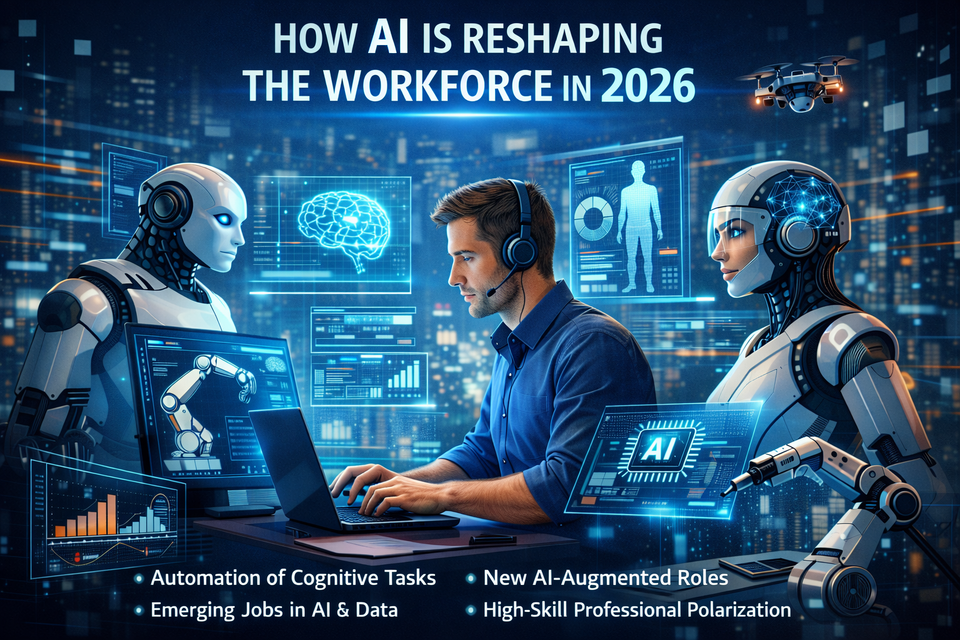
Artificial Intelligence has transitioned from experimental innovation to operational necessity. In 2026, AI systems are deeply embedded in daily business processes, decision-making frameworks, and professional workflows across industries. What was once considered technological disruption is now structural transformation.
The modern workforce is not being replaced wholesale by artificial intelligence. Rather, it is being redefined. Roles are evolving, skill expectations are shifting, and organizations are redesigning how value is created.
This article provides a comprehensive analysis of how AI is transforming today’s jobs, the structural shifts underway, and what professionals and businesses must understand to remain competitive.
The Structural Shift: From Task Execution to Cognitive Oversight
Historically, automation targeted repetitive, manual processes. In 2026, AI operates at a far more advanced cognitive level. Machine learning systems and generative models now perform:
- Data interpretation and predictive analytics
- Content drafting and summarization
- Code generation and debugging assistance
- Financial modeling
- Customer interaction management
- Risk assessment and anomaly detection
The defining shift is not job elimination, but task reallocation.
Professionals are moving from direct execution toward supervision, validation, optimization, and strategic application of AI-generated outputs. The value of human contribution increasingly lies in oversight, contextual understanding, and decision-making rather than raw production.
AI-Augmented Professionals: The New Standard
In 2026, the competitive advantage belongs to AI-augmented professionals — individuals who integrate artificial intelligence into their workflow to increase productivity, precision, and strategic capacity.
Across industries:
- Software developers utilize AI-assisted programming tools to accelerate development cycles.
- Marketing professionals rely on predictive segmentation and AI-driven content modeling.
- HR departments implement AI-based candidate pre-screening systems.
- Financial analysts leverage automated forecasting engines.
- Cybersecurity teams deploy AI-powered threat detection mechanisms.
The professional question is no longer whether AI will influence a role, but how effectively an individual can leverage it.
This marks the emergence of a new baseline competency: operational AI literacy.
Transformation Within the IT Sector
The IT industry offers a clear case study of AI integration.
Software Development
AI-assisted coding platforms reduce development time by automating boilerplate code, generating test cases, and identifying optimization opportunities. Developers are increasingly responsible for architecture design, system reliability, and integration complexity rather than manual coding tasks alone.
DevOps and Infrastructure
AI-driven monitoring systems can predict outages, detect configuration anomalies, and optimize cloud resource allocation automatically. DevOps engineers now focus on automation frameworks, resilience engineering, and cross-system orchestration.
Cybersecurity
Threat detection systems powered by AI identify behavioral anomalies and attack patterns in real time. Security professionals interpret alerts, refine detection logic, and design defensive strategies rather than manually scanning logs.
System Administration
Routine configuration and maintenance are increasingly automated. System administrators evolve into infrastructure strategists, automation architects, and security hardening specialists.
In each case, AI does not remove the role — it elevates its complexity.
The Emergence of New Professional Categories
AI adoption has also created entirely new career pathways. In 2026, growing roles include:
- AI Systems Integration Specialist
- Machine Learning Operations (MLOps) Engineer
- AI Compliance and Governance Officer
- Data Ethics Consultant
- AI Workflow Architect
- Human–AI Interaction Designer
Organizations now require specialists who can implement AI responsibly, maintain model performance, mitigate bias, and ensure regulatory alignment.
AI is not only transforming existing jobs — it is constructing a new professional ecosystem.
Skill Polarization and Labor Market Realignment
One of the most significant consequences of AI expansion is labor market polarization.
High-skill professionals who integrate AI effectively are experiencing productivity gains and compensation growth. Meanwhile, roles centered on repetitive cognitive tasks face compression or elimination.
Entry-level positions that historically involved routine analysis, basic reporting, or standardized documentation are particularly affected.
This dynamic creates urgency for workforce upskilling. Continuous learning is no longer a strategic advantage — it is a professional requirement.
The Rising Importance of Human-Centric Skills
Paradoxically, as machines become more capable, distinctly human capabilities gain importance.
In 2026, the most valued competencies include:
- Critical thinking
- Complex problem framing
- Ethical reasoning
- Strategic judgment
- Communication and stakeholder alignment
- Creative synthesis
AI can generate outputs, but it cannot independently define organizational priorities, interpret nuanced social contexts, or make ethically accountable decisions.
Human oversight remains indispensable.
Organizational Transformation
Companies are not merely adopting AI tools — they are restructuring around them.
Key organizational changes include:
- AI-first workflow design
- Automation-driven cost modeling
- Data-centric operational strategies
- Cross-functional AI governance committees
- Increased investment in cybersecurity and compliance
Executives now treat AI integration as a board-level priority rather than a departmental initiative.
Businesses that fail to adapt risk operational inefficiency and competitive decline.
Risk, Regulation, and Ethical Considerations
The expansion of AI introduces governance challenges.
Concerns include:
- Algorithmic bias
- Data privacy violations
- Security vulnerabilities
- Overreliance on automated decision-making
- Workforce displacement
Regulatory frameworks in multiple jurisdictions now require transparency, auditability, and risk management in AI deployment.
As a result, ethical AI implementation has become both a legal and strategic necessity.
Strategic Recommendations for Professionals in 2026
To remain competitive in an AI-integrated labor market, professionals should:
- Develop foundational understanding of AI systems and limitations.
- Integrate automation into daily workflows.
- Strengthen analytical and strategic thinking capabilities.
- Invest in technical upskilling where applicable (cloud, cybersecurity, data, infrastructure).
- Build cross-disciplinary communication skills.
The most effective approach is not resistance to AI — but strategic adoption.
Conclusion: AI as a Force Multiplier, Not a Replacement
Artificial Intelligence in 2026 is not a job destroyer in isolation. It is a force multiplier.
It amplifies productivity.
It reshapes task distribution.
It raises the skill ceiling.
It increases competitive differentiation.
The modern professional landscape favors those who adapt quickly, learn continuously, and integrate technology strategically.
AI is not ending careers.
It is redefining them.