
RHCSA vs LFCS vs LPIC: The Ultimate Linux Certification Comparison (2026 Edition)
If you are serious about building a career in Linux system administration, you’ve likely encountered three major certification paths:
- Red Hat – RHCSA
- The Linux Foundation – LFCS
- Linux Professional Institute – LPIC
But which one should you choose?
This comprehensive guide compares RHCSA, LFCS, and LPIC in depth — covering exam structure, cost, difficulty, recognition, job market value, and long-term strategy.
1️⃣ RHCSA – Red Hat Certified System Administrator
Official page:
👉 https://www.redhat.com/en/services/certification/rhcsa
Overview
RHCSA (EX200) is one of the most respected Linux certifications globally. It focuses specifically on Red Hat Enterprise Linux (RHEL) environments.
Key Facts
- Vendor-specific (Red Hat Enterprise Linux)
- 100% performance-based exam
- Hands-on practical lab
- Exam duration: ~2.5 hours
- Cost: ~$400 (varies by region)
What You Learn
- User & group management
- SELinux configuration
- Storage management (LVM, partitions)
- Networking basics
- Systemd services
- Firewalld configuration
- Containers (basic level)
Strengths
✔ Extremely respected in enterprise
✔ Real hands-on exam
✔ Strong employer recognition
✔ High ROI in corporate environments
Weaknesses
✖ Vendor-specific (RHEL only)
✖ More expensive
✖ Requires deep hands-on practice
Who Should Choose RHCSA?
- You want to work in enterprise environments
- Your company uses RHEL
- You aim for DevOps / Cloud / Enterprise SysAdmin roles
- You want maximum credibility
2️⃣ LFCS – Linux Foundation Certified System Administrator
Official page:
👉 https://training.linuxfoundation.org/certification/linux-foundation-certified-sysadmin-lfcs/
Overview
LFCS is administered by The Linux Foundation, the organization behind the Linux kernel project.
It is vendor-neutral but performance-based, which makes it unique.
Key Facts
- Vendor-neutral
- Performance-based exam
- Online proctored
- Choose distribution (Ubuntu, CentOS, etc.)
- Cost: ~$395
What You Learn
- Command line mastery
- File systems
- Networking configuration
- Service management
- User administration
- Storage
- Security basics
Strengths
✔ Real practical exam
✔ Vendor-neutral flexibility
✔ Highly technical
✔ Remote exam option
Weaknesses
✖ Slightly less HR recognition than RHCSA
✖ Still requires strong practical skills
Who Should Choose LFCS?
- You prefer Ubuntu or non-RHEL systems
- You want vendor-neutral credibility
- You want a practical exam without Red Hat lock-in
- You plan to work in cloud-native environments
3️⃣ LPIC (LPIC-1, LPIC-2, LPIC-3)
Official page:
👉 https://www.lpi.org/our-certifications/
Overview
LPIC is offered by the Linux Professional Institute and is fully vendor-neutral.
Unlike RHCSA and LFCS, LPIC exams are theory + multiple choice rather than fully hands-on.
LPIC Levels
- LPIC-1 → Junior Linux Admin
- LPIC-2 → Advanced Linux Admin
- LPIC-3 → Enterprise specialization
Key Facts
- Vendor-neutral
- Multiple-choice format
- Two exams per level
- Cost: ~$200 per exam
What You Learn
- GNU/Linux commands
- Bash scripting
- Networking
- Security
- Kernel basics
- Package management across distros
Strengths
✔ Structured multi-level path
✔ Good global recognition
✔ Strong theoretical foundation
✔ Cheaper entry point
Weaknesses
✖ Not performance-based
✖ Less practical than RHCSA/LFCS
✖ Some employers prefer hands-on exams
Who Should Choose LPIC?
- Beginners starting Linux journey
- Those who want structured long-term roadmap
- People targeting global job markets
- Students building foundational knowledge
Direct Comparison Table
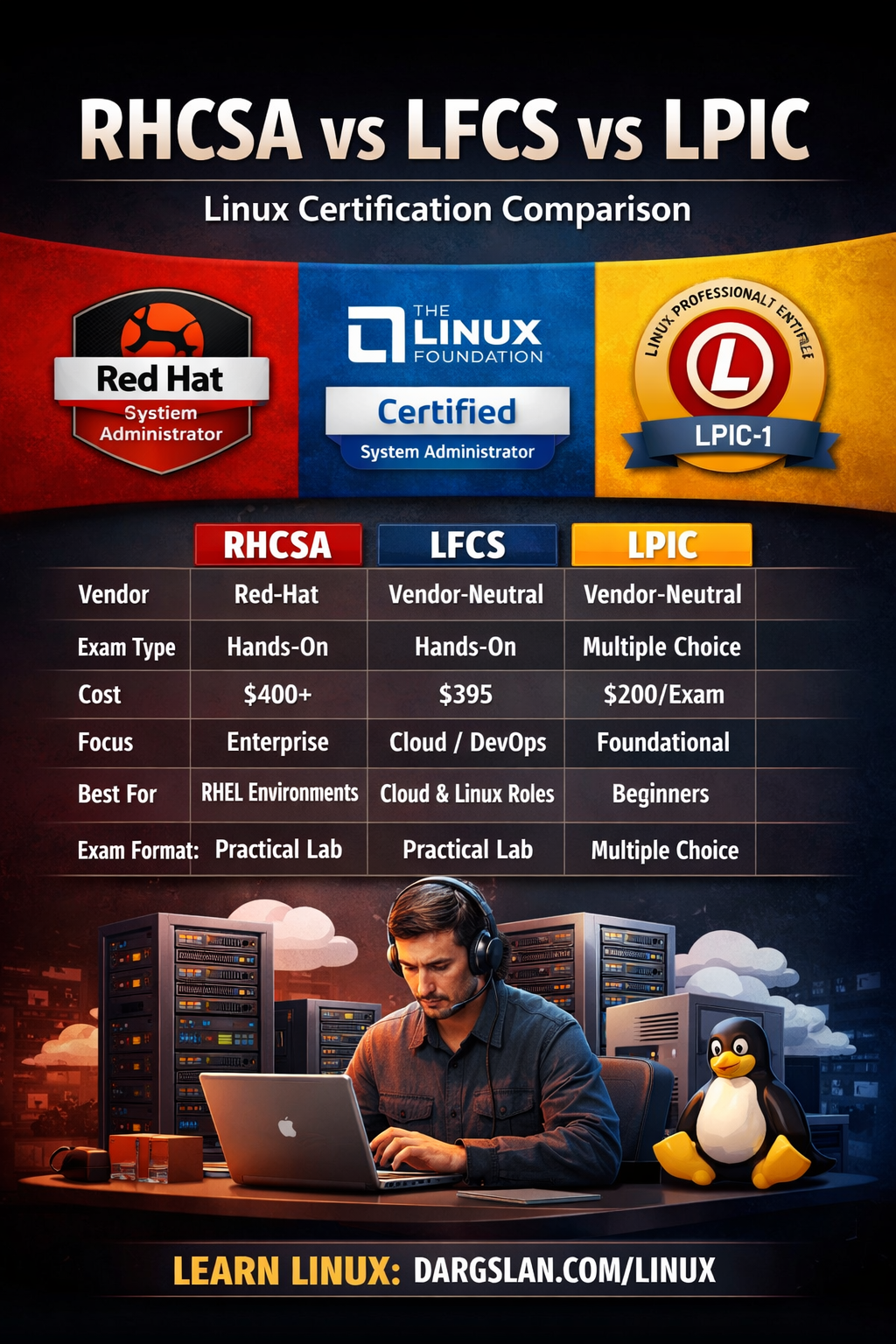
| Feature | RHCSA | LFCS | LPIC |
|---|---|---|---|
| Vendor Specific | Yes (RHEL) | No | No |
| Exam Type | Hands-on | Hands-on | Multiple Choice |
| Recognition | Very High | High | High |
| Enterprise Value | Excellent | Strong | Moderate |
| Beginner Friendly | Medium | Medium | High |
| Cost | $$$ | $$$ | $$ |
| Practical Skills | Very High | High | Medium |
Which Certification Has the Highest ROI?
Enterprise Career → RHCSA Wins
Red Hat dominates enterprise Linux. RHCSA is highly respected by hiring managers.
Cloud / DevOps → LFCS is Strong
Vendor-neutral + practical exam makes it excellent for cloud-native environments.
Academic / Foundational Path → LPIC
If you want structured progression and solid theory, LPIC is ideal.
Industry Demand & Market Perspective
Linux powers:
- 96% of top 1 million web servers
- Most cloud infrastructure
- Containers (Docker, Kubernetes)
- DevOps environments
Certifications prove structured knowledge and reduce employer risk when hiring.
However, certification alone is NOT enough. Real labs, automation, scripting, and troubleshooting practice are essential.
Strategic Recommendation (2026)
If you want maximum career leverage:
1️⃣ Start with LPIC-1 (foundation)
2️⃣ Move to LFCS (practical validation)
3️⃣ Finish with RHCSA (enterprise credibility)
This triple path builds unbeatable Linux authority.
Final Thoughts
There is no single “best” Linux certification — only the one aligned with your career goals.
- Want enterprise prestige? → RHCSA
- Want vendor-neutral practical exam? → LFCS
- Want structured roadmap? → LPIC
The key is not just passing the exam — but mastering Linux deeply.
🚀 Want Real Linux Mastery?
If you're preparing for any Linux certification — RHCSA, LFCS, or LPIC — and you want structured, practical, beginner-to-advanced resources:
👉 Explore our complete Linux learning library here:
👉 https://dargslan.com/category/linux
Build real skills. Practice daily. Master Linux.