
Why Learning Linux in 2026 Is Still One of the Smartest Career Decisions
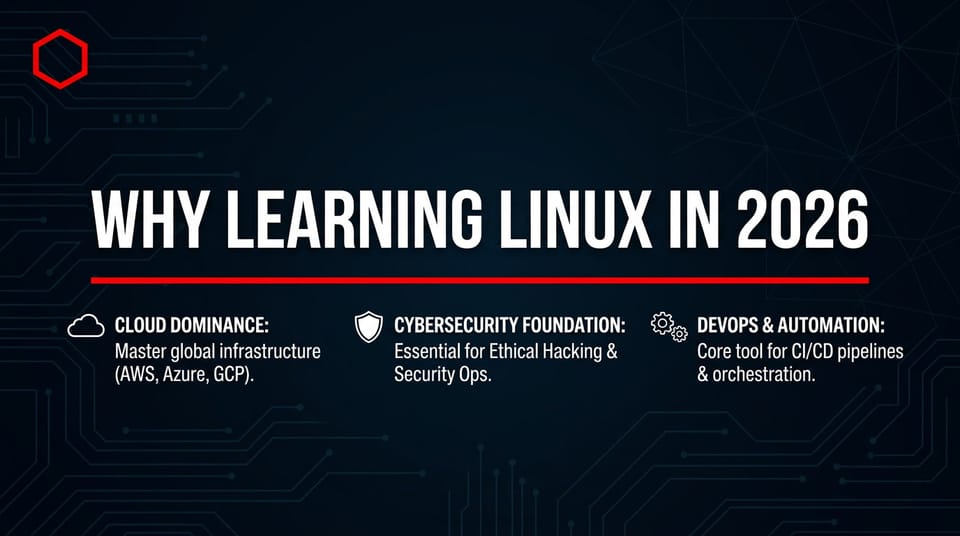
In an era dominated by cloud computing, automation, and artificial intelligence, some foundational technologies continue to define how modern systems operate. One of the most important among them is Linux.
Despite rapid changes in the technology landscape, Linux remains deeply embedded in the infrastructure that powers the internet, enterprise systems, and emerging platforms. In 2026, learning Linux is not just relevant — it is a strategic advantage.
Linux Powers the Modern Digital World
Many users interact daily with applications and services without realizing that Linux operates behind the scenes.
From web servers and cloud environments to container platforms and networking systems, Linux is everywhere. Major cloud providers such as AWS, Azure, and Google Cloud rely heavily on Linux-based systems to deliver scalable and reliable services.
This means that understanding Linux gives professionals insight into how modern infrastructure actually works, rather than just interacting with it at a surface level.
A Core Skill for Cloud and DevOps
As organizations continue to adopt cloud-native architectures, the demand for professionals with Linux knowledge continues to grow.
DevOps practices, in particular, depend heavily on Linux environments. Technologies such as Docker, Kubernetes, and CI/CD pipelines are built on top of Linux systems and tools.
Without a solid understanding of Linux, it becomes significantly more difficult to manage deployments, troubleshoot issues, or automate infrastructure effectively.
Learning Linux allows professionals to move beyond using tools and toward understanding the systems that power them.
Essential for Cybersecurity
Cybersecurity is another area where Linux plays a central role.
Many security tools and frameworks are designed specifically for Linux systems. Professionals working in penetration testing, incident response, and system hardening frequently rely on Linux environments.
Learning Linux not only helps in defending systems but also in understanding how attacks are executed and how vulnerabilities can be identified and mitigated.
This dual perspective is critical in modern security roles.
Building Stronger Problem-Solving Skills
One of the most valuable aspects of learning Linux is the mindset it develops.
Unlike graphical operating systems, Linux encourages users to interact directly with the system through the command line. This approach promotes a deeper understanding of processes, logs, and system behavior.
As a result, professionals develop stronger troubleshooting and problem-solving skills.
Instead of relying on visual interfaces, they learn how to:
- analyze logs
- understand system processes
- automate repetitive tasks
- diagnose issues efficiently
These skills are transferable across many areas of IT.
Relevant Across Multiple Career Paths
Linux is not limited to a single role or specialization.
It is widely used across:
- system administration
- DevOps engineering
- cloud engineering
- backend development
- cybersecurity
This makes Linux one of the most versatile skills in the IT industry.
Even professionals who do not work directly with infrastructure benefit from understanding Linux, as it improves collaboration with operations and deployment teams.
Learning Linux Is About Understanding, Not Memorization
A common misconception is that learning Linux requires memorizing hundreds of commands.
In reality, the key is understanding patterns and principles.
Most professionals rely on a core set of commands and expand their knowledge over time through practical use. The ability to navigate systems, interpret output, and troubleshoot effectively is far more valuable than memorizing syntax.
With consistent practice, Linux becomes intuitive.
Linux and the Future of Technology
Looking ahead, Linux will continue to play a foundational role in emerging technologies.
Artificial intelligence infrastructure, edge computing, container orchestration, and distributed systems all rely heavily on Linux-based environments.
As these technologies evolve, the importance of Linux knowledge will only increase.
Final Thoughts
In 2026, learning Linux is not just about acquiring another technical skill. It is about gaining a deeper understanding of how modern systems operate.
It provides a foundation that supports multiple career paths and enables professionals to work more effectively in complex environments.
For anyone serious about building a career in IT, DevOps, cloud computing, or cybersecurity, Linux remains one of the smartest and most future-proof investments.